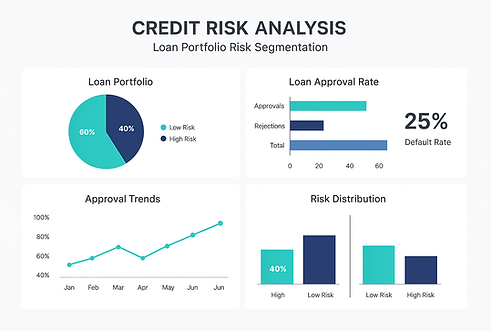
In the fintech industry, accurate credit risk assessment is crucial to minimising loan defaults while maintaining a healthy loan approval rate.
This project develops a machine learning-based Credit Risk Scoring system that predicts the probability of a borrower defaulting, enabling financial institutions to make data-driven, compliant, and scalable lending decisions.
The solution is built with Python, scikit-learn, and XGBoost, deployed as a REST API via Flask and Docker, and integrated with an interactive Power BI dashboard for portfolio monitoring.
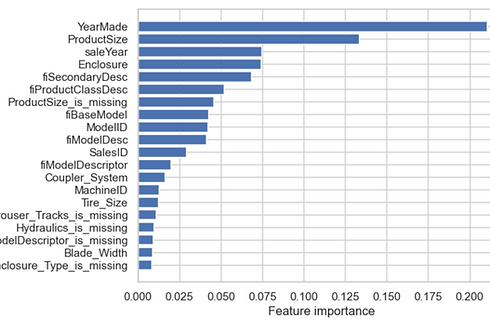
Developed a regression model to predict the future sale prices of bulldozers using historical auction data from the Kaggle Bluebook for Bulldozers competition. The project involved data cleaning, feature engineering (e.g., extracting time-based features), exploratory data analysis, and training machine learning models including Random Forests and Gradient Boosting. Model performance was evaluated using Root Mean Squared Log Error (RMSLE), achieving strong predictive accuracy on validation data. This project highlights my skills in handling structured datasets, applying machine learning techniques, and delivering actionable insights.
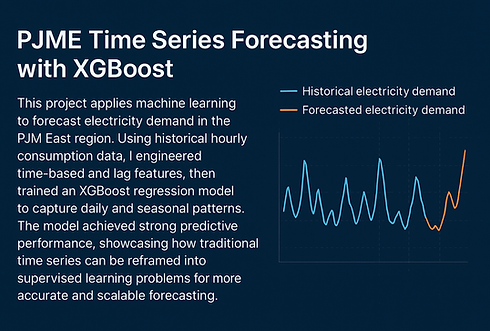
This project applies machine learning to forecast electricity demand in the PJM East region. Using historical hourly consumption data, I engineered time-based and lag features, then trained an XGBoost regression model to capture daily and seasonal patterns. The model achieved strong predictive performance, showcasing how traditional time series can be reframed into supervised learning problems for more accurate and scalable forecasting.

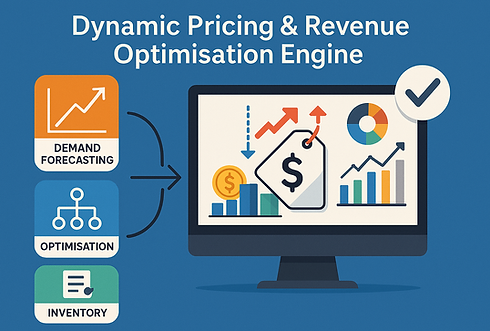
This project develops a Dynamic Pricing & Revenue Optimisation Engine that uses machine learning demand forecasting and mathematical optimisation to set optimal prices for products or services.
It’s designed for automotive dealerships, ride-hailing platforms, and e-commerce environments where demand fluctuates based on seasonality, competition, and inventory levels.
The engine leverages historical sales data, market trends, and inventory constraints to suggest optimal pricing strategies in real time, with deployment-ready APIs for integration into live business systems.
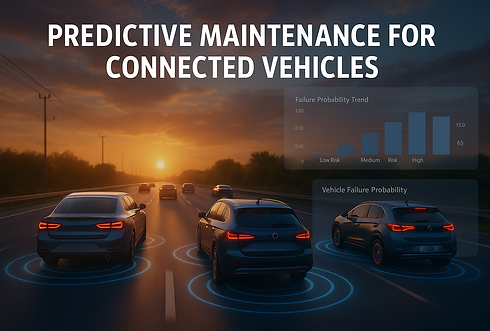
This project develops a Predictive Maintenance system for connected vehicles, leveraging telematics and sensor data to predict component failures before they occur.
The solution applies time-series forecasting and anomaly detection techniques to provide early warnings, enabling proactive maintenance scheduling, cost reduction, and improved customer experience.
Designed for automotive manufacturers and service providers, this system integrates machine learning models, cloud-based data pipelines, and interactive dashboards to deliver actionable insights in near real time.